Ferrari
Automotive • In-house Ferrari

 Reversed logo
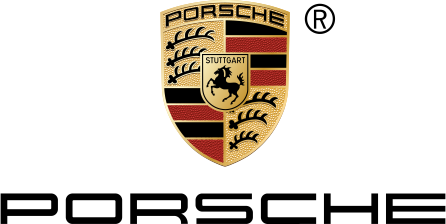
Porsche's crest combines the rearing horse from the seal of Stuttgart with the red-and-black bars and antlers of the Wurttemberg-Hohenzollern coat of arms, all set within a shield shape topped by the 'Porsche' wordmark. The 2023 refinement introduced a three-dimensional honeycomb structure in the red bands, brushed precious metal finishes, and a more dynamic horse silhouette, executed over a three-year design process
The Porsche crest is one of the most layered automotive emblems still in active use, packing heraldic symbolism from two distinct sources into a single shield. At the center sits a rearing horse borrowed from the seal of Stuttgart, a city whose name translates to “stud garden” from its horse-breeding history. Surrounding the horse are red (#D5001C) and black (#000000) horizontal bars and stylized deer antlers drawn from the traditional coat of arms of Wurttemberg-Hohenzollern, the region that houses Porsche’s Zuffenhausen headquarters. Gold frames the entire composition and carries the “Porsche” lettering at the top and “Stuttgart” above the horse. Unlike the flat-design trend reshaping most automotive badges, the 2023 crest leans further into physical dimensionality, adding honeycomb textures and brushed metal finishes that reward close inspection.
Porsche produced its first road-approved car, the 356 “No.1” Roadster, in 1948, but operated without a crest for four years. The idea for a logo emerged in late 1951 during a conversation between Ferry Porsche and American importer Max Hoffman. Franz Xaver Reimspiess, the designer believed to have also drawn the Volkswagen logo in 1936, sketched the first crest early in 1952. It appeared on steering wheel rims by the end of that year and was integrated into the hood handle of the 356 Speedster in November 1954. Since then, the crest has been updated six times: 1954, 1963, 1973, 1994, 2008, and 2023. The latest revision, led by Michael Mauer (Vice President Style Porsche) and Matthias Kulla (Director of Design Management), took three years to complete and was timed to the brand’s 75th anniversary celebration on June 8, 2023.
Where most competitors have moved toward flat, monochrome marks optimized for screens, Porsche chose to double down on tactile complexity. The 2023 crest introduces a honeycomb structure in the red bands, referencing the lightweight construction principles that define Porsche’s engineering DNA. The hexagonal cells contain subtle tonal variation that creates a three-dimensional effect on a physical badge. Brushed precious metal replaces the textured gold of the previous version, giving the background a cleaner, more contemporary finish. The horse itself was redrawn to appear more dynamic and angular, with Porsche describing the goal as making it look more like a thoroughbred. The gold tone was darkened to a more subtle bronze, and the “Stuttgart” lettering above the horse was set in black for the first time. Each of these adjustments was calibrated so that the 2D and 3D versions of the crest match as closely as possible, ensuring consistency between physical badges and digital applications.
The crest anchors a brand architecture that includes Porsche (core sports cars), Porsche Design (lifestyle and accessories), and the Taycan-led electric vehicle range. Robert Ader, Chief Marketing Officer, noted that the 2023 update prompted a broader rework of Porsche’s brand design, with the crest reserved for emotional highlights while the “Porsche” wordmark in Porsche Next, the proprietary geometric sans-serif, takes on greater prominence in everyday communications. On vehicles, the crest appears on the hood, steering wheel hub, wheel centers, and key fob. Porsche Classic offers every historical crest version through its original parts program, manufactured using period-correct processes and special tooling, an approach that treats the logo not just as a brand element but as a collectible artifact.
The Porsche crest has persisted for over seven decades without a fundamental redesign, a rarity in an industry that routinely flattens, simplifies, or completely replaces its marks. The emblem’s density of detail, a horse, antlers, bars, lettering, shield outline, all in a space smaller than a playing card, runs counter to every principle of modern logo minimalism, yet it remains one of the most coveted badges in automotive culture. Its resistance to simplification reflects a brand proposition built on specificity rather than universality: Porsche makes sports cars, and the crest’s complexity signals that same attention to engineering detail. The 2023 honeycomb addition reinforces rather than softens this message, adding a layer of technical reference that rewards the kind of close-up scrutiny Porsche owners apply to every panel gap and stitch line.
Maintain adequate clear space around the Porsche logo to ensure visual integrity and maximum legibility. The minimum exclusion zone equals the height of the logo's cap height (represented as "x") on all sides. This protective space prevents the logo from appearing cluttered when placed near other graphic elements, text, or page edges.
Ratio: 2.0 : 1
ViewBox: 55 × 27
Preserve the integrity of the Porsche logo by avoiding unauthorized modifications. Consistent application across all touchpoints strengthens brand recognition and maintains professional standards. The examples below illustrate common misuses that compromise the logo's visual impact and brand identity.
Don't rotate
Don't skew
Don't stretch
Don't recolor
Don't add shadows
Don't crop
Don't outline
Don't place on busy backgrounds
The Porsche logo uses 2 colors: Porsche Black (#000000) and Porsche Red (#D5001C). These values are used consistently across all official Porsche brand materials.
Yes. Click the Download SVG button at the top of this page to get a production-ready vector file. SVG format scales to any size without quality loss, making it ideal for websites, presentations, and print materials.
The Porsche logo was designed by In-house Porsche in 2023. The design has become one of the better-known marks in the Automotive space.
Maintain clear space equal to the logo's cap height on all sides. Do not rotate, skew, stretch, recolor, crop, or add effects to the logo. Always use the official SVG file and ensure sufficient contrast with the background.
A reverse logo is a white or light version designed for use on dark backgrounds. It maintains the same proportions as the primary Porsche logo while ensuring legibility on brand-colored surfaces, dark packaging, or apparel.
The Porsche logo uses Porsche Next. For accurate representation, always use the official vector logo rather than attempting to recreate the typography.
Commercial use of the Porsche logo typically requires written permission from Porsche. The logo is trademarked intellectual property, so while editorial use and accurate product references are generally permitted, promotional or commercial use needs authorization. Do not alter the logo or use it to imply endorsement.