Jaguar
Automotive • Gerry McGovern

 Reversed logo
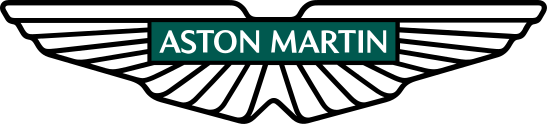
Aston Martin's winged wordmark places the brand name in a bespoke sans-serif across a central lozenge flanked by stylized wings inspired by Egyptian scarab beetles. Peter Saville's 2022 refinement removed the semi-circular line, thickened the wing vanes, and replaced gradient shading with solid Aston Martin Green (#005643)
Aston Martin’s logo is a horizontal winged emblem with the brand name set in a bespoke uppercase sans-serif across a central lozenge in Aston Martin Green (#005643). The wings extend symmetrically on either side, their interior lines suggesting feathered vanes that taper to fine points. Peter Saville’s 2022 refinement, the eighth significant update in the marque’s history, removed a semi-circular line that had run behind the wordmark, thickened the remaining wing structures for digital clarity, and replaced gradient shading with a solid green fill. The physical badge is hand-enamelled by Vaughtons, a 203-year-old silversmith firm in Birmingham’s jewellery quarter, connecting the digital identity to a tangible craft tradition.
Lionel Martin and Robert Bamford founded Aston Martin in 1913, with the name combining “Aston” from the Aston Clinton hillclimb where Martin competed and his own surname. The first logo in 1921 was a circular monogram of intertwined “A” and “M” letters. In 1927, the wings appeared for the first time as a wing-shaped wordmark stretched horizontally. The 1932 redesign by SCH Davis introduced the scarab beetle-inspired wing silhouette that persists today, chosen for the scarab’s association with new beginnings in Egyptian mythology. Subsequent updates in the 1950s, David Brown era (1947-1972), 1984, and 2003 refined proportions and detail but maintained the fundamental form. Peter Saville, known for his Factory Records album covers including Joy Division’s Unknown Pleasures, was brought in by Chief Creative Officer Marek Reichman for the 2022 update. Saville described the changes as “subtle but necessary enhancements” to accommodate new technologies, digital applications, and future product.
The 2022 wings address a specific problem: the previous logo’s fine details collapsed at small digital sizes. Saville removed visual noise, particularly the semi-circular line behind the wordmark that blurred on smartphone screens, and thickened the remaining lines to maintain legibility from 16-pixel favicons to 60-foot billboards. The bespoke sans-serif wordmark, developed with type foundry Dalton Maag, replaced letterforms that previously resembled Optima, a humanist sans-serif. The solid Aston Martin Green in the central lozenge anchors the mark in British Racing Green heritage without attempting to replicate any specific racing shade. The wing geometry still carries the 1932 scarab influence, with each vane drawn to suggest both feathered flight and aerodynamic surfaces, making the badge function simultaneously as heraldic device and engineering reference.
Aston Martin’s identity system operates under the tagline “Intensity. Driven.” introduced alongside the 2022 rebrand. The wings serve as the singular brand mark across the entire portfolio, from the DB12 grand tourer and Vantage sports car to the Valkyrie hypercar and the Aston Martin Aramco Formula One team. The physical badge’s production at Vaughtons, the same Birmingham firm that crafted the FA Cup trophy and 1908 Olympic medals, positions the emblem as jewelry rather than mere automotive trim. Green dominates the color system, extending through the F1 livery’s Aston Martin Racing Green to dealer environments, digital platforms, and printed materials. The brand architecture is flat: unlike some competitors, Aston Martin applies the same wings across all models without sub-brand marks, letting price and specification differentiate tiers from the Vantage entry point through the limited-production Valkyrie.
The wings have appeared in twelve James Bond films, beginning with the DB5 in Goldfinger (1964), creating an association between the emblem and cinematic sophistication that no amount of advertising could replicate. This Bond connection gave the wings cultural reach far beyond the automotive world, embedding them in popular consciousness as shorthand for British elegance and controlled aggression. On the racing circuit, the 1959 Le Mans victory with the DBR1 wearing British Racing Green established the color-wing combination that the F1 team revived in 2021 after a 61-year absence from open-wheel racing. The brand’s survival through multiple ownership changes, financial crises, and seven bankruptcies makes the wings’ continuity itself a statement: across 110 years and eight logo iterations, the fundamental winged form introduced in 1927 has never been abandoned.
Maintain adequate clear space around the Aston Martin logo to ensure visual integrity and maximum legibility. The minimum exclusion zone equals the height of the logo's cap height (represented as "x") on all sides. This protective space prevents the logo from appearing cluttered when placed near other graphic elements, text, or page edges.
Ratio: 4.4 : 1
ViewBox: 547 × 124
Preserve the integrity of the Aston Martin logo by avoiding unauthorized modifications. Consistent application across all touchpoints strengthens brand recognition and maintains professional standards. The examples below illustrate common misuses that compromise the logo's visual impact and brand identity.
Don't rotate
Don't skew
Don't stretch
Don't recolor
Don't add shadows
Don't crop
Don't outline
Don't place on busy backgrounds
The Aston Martin logo uses 2 colors: Aston Martin Green (#005643) and White (#FFFFFF). These values are used consistently across all official Aston Martin brand materials.
Yes. Click the Download SVG button at the top of this page to get a production-ready vector file. SVG format scales to any size without quality loss, making it ideal for websites, presentations, and print materials.
The Aston Martin logo was designed by Peter Saville in 2022. The design has become one of the better-known marks in the Automotive space.
Maintain clear space equal to the logo's cap height on all sides. Do not rotate, skew, stretch, recolor, crop, or add effects to the logo. Always use the official SVG file and ensure sufficient contrast with the background.
A reverse logo is a white or light version designed for use on dark backgrounds. It maintains the same proportions as the primary Aston Martin logo while ensuring legibility on brand-colored surfaces, dark packaging, or apparel.
The Aston Martin logo uses Aston Martin Sans. For accurate representation, always use the official vector logo rather than attempting to recreate the typography.
Commercial use of the Aston Martin logo typically requires written permission from Aston Martin. The logo is trademarked intellectual property, so while editorial use and accurate product references are generally permitted, promotional or commercial use needs authorization. Do not alter the logo or use it to imply endorsement.