Porsche
Automotive • In-house Porsche

 Reversed logo
 Ferrari's Cavallino Rampante, a black prancing horse on a canary yellow shield topped with the Italian tricolore, is one of the most recognized automotive emblems on earth. The mark traces directly to WWI flying ace Francesco Baracca, whose family granted Enzo Ferrari permission to adopt the symbol in the 1920s
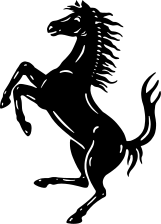
The Ferrari emblem centers on a black prancing horse (Cavallino Rampante) set against a canary yellow (#FFF200) shield, crowned by three horizontal bands of the Italian tricolore (green, white, red) and anchored by either the “Ferrari” wordmark or the initials “SF” for Scuderia Ferrari. The horse faces left, standing on its hind legs with tail raised, a silhouette so distinctive it functions as a standalone mark on wheel centers, key fobs, and merchandise without the surrounding shield. Two versions coexist: the rectangular format bearing the full “Ferrari” name for the road car division, and the shield format carrying the “SF” initials for the racing team. Both share the same horse, the same yellow ground, and the same tricolore strip, differing only in frame shape and bottom text.
The Cavallino Rampante originated with Francesco Baracca, an Italian fighter ace who painted a black horse on the fuselage of his aircraft beginning in 1917, adapting the emblem of the 2nd “Piemonte Cavalleria” cavalry regiment he had served in. After Baracca’s death in combat on June 19, 1918, his parents preserved the symbol. In 1923, following a race victory at the Circuito del Savio in Ravenna, Enzo Ferrari met Countess Paolina Baracca, who suggested he adopt her son’s horse for good luck. Enzo accepted but waited nine years: the Cavallino debuted on July 9, 1932, at the Spa 24 Hours on Alfa Romeo 8C 2300s entered by Scuderia Ferrari. In 1945, Enzo commissioned Milanese engraver Eligio Gerosa to redesign the horse with the tail facing upward rather than downward, creating the silhouette still in use today. Enzo directed Gerosa to avoid curves, which reminded him of Bugatti grilles, and specified the horse must always face left. The yellow background was added as a tribute to Modena, Enzo’s hometown. Subtle refinements followed in 1981 (sharper contours, silver frame), 1994 (sleeker proportions), and 2002 (more dynamic stance, brighter colors, cleaner tricolore). In early 2018, under President Sergio Marchionne, Scuderia Ferrari returned from the Marlboro-styled wordmark to the classic shield emblem on its F1 livery and social media profiles.
Ferrari’s emblem operates through layered symbolism rather than graphic abstraction. The black horse against yellow maximizes luminance contrast, ensuring visibility at racing speed, on small badge scales, and across merchandise. Enzo’s insistence that the horse face left, combined with the raised tail and all four hooves off the ground, creates a silhouette that conveys forward motion without requiring any additional graphic device. The canary yellow (Giallo Modena, #FFF200) anchors the composition with a hue that reads as gold under warm light and electric yellow under cool light, giving the mark environmental adaptability. The tricolore band is not decorative but structural: it separates the horse from the frame’s upper edge and declares national origin, reinforcing the association between Ferrari and Italian manufacturing heritage. The choice to maintain two parallel formats, shield for racing and rectangle for road cars, allows the brand to modulate formality without altering the core symbol.
Ferrari’s visual system extends Rosso Corsa (#DC0000) across every touchpoint, from vehicle paint (where it remains the most ordered color) to F1 livery, retail environments, and the Ferrari Sans proprietary typeface used in corporate communications. The brand operates a strict licensing regime: the Cavallino silhouette, the shield composition, and even the distinctive shapes of certain vehicle models are protected as trade dress. Sub-brands include Scuderia Ferrari (racing), Ferrari Classiche (heritage certification), Ferrari Design (lifestyle products), and the more recent electric vehicle program anchored by the first all-electric Ferrari. Merchandising generates substantial revenue independent of vehicle sales, with the prancing horse appearing on clothing, watches, and accessories under tightly controlled guidelines that preserve the mark’s scarcity value.
The Cavallino Rampante operates at a recognition level that extends well beyond automotive enthusiasts, ranking among the most identifiable corporate symbols globally. Its power lies in the convergence of military history, motorsport dominance, and deliberate scarcity: Ferrari produces fewer cars annually than most competitors sell in a month, turning the emblem into a marker of exclusivity. Four decades of Formula 1 success, from Alberto Ascari through Michael Schumacher to Charles Leclerc, cemented the shield variant as shorthand for competitive excellence. The horse’s journey from a WWI fighter plane to the most valuable luxury automotive brand in the world (exceeding $35 billion in brand value) demonstrates that the strongest marks carry meaning that predates and transcends the companies that adopt them.
Maintain adequate clear space around the Ferrari logo to ensure visual integrity and maximum legibility. The minimum exclusion zone equals the height of the logo's cap height (represented as "x") on all sides. This protective space prevents the logo from appearing cluttered when placed near other graphic elements, text, or page edges.
Ratio: 1 : 1.4
ViewBox: 161 × 224
Preserve the integrity of the Ferrari logo by avoiding unauthorized modifications. Consistent application across all touchpoints strengthens brand recognition and maintains professional standards. The examples below illustrate common misuses that compromise the logo's visual impact and brand identity.
Don't rotate
Don't skew
Don't stretch
Don't recolor
Don't add shadows
Don't crop
Don't outline
Don't place on busy backgrounds
The Ferrari logo uses 2 colors: Rosso Corsa (#DC0000) and Giallo Modena (#FFF200). These values are used consistently across all official Ferrari brand materials.
Yes. Click the Download SVG button at the top of this page to get a production-ready vector file. SVG format scales to any size without quality loss, making it ideal for websites, presentations, and print materials.
The Ferrari logo was designed by In-house Ferrari in 2002. The design has become one of the better-known marks in the Automotive space.
Maintain clear space equal to the logo's cap height on all sides. Do not rotate, skew, stretch, recolor, crop, or add effects to the logo. Always use the official SVG file and ensure sufficient contrast with the background.
A reverse logo is a white or light version designed for use on dark backgrounds. It maintains the same proportions as the primary Ferrari logo while ensuring legibility on brand-colored surfaces, dark packaging, or apparel.
The Ferrari logo uses Ferrari Sans. For accurate representation, always use the official vector logo rather than attempting to recreate the typography.
Commercial use of the Ferrari logo typically requires written permission from Ferrari. The logo is trademarked intellectual property, so while editorial use and accurate product references are generally permitted, promotional or commercial use needs authorization. Do not alter the logo or use it to imply endorsement.