The Guardian
Media • In-house Guardian

 Reversed logo
 Penguin's mascot, a forward-facing penguin in clean black outline on Blaze Orange (#FF6900), is one of publishing's most recognized symbols. First sketched by Edward Young in 1935 and refined by Jan Tschichold in 1946, the current Pentagram version preserves the bird's geometry
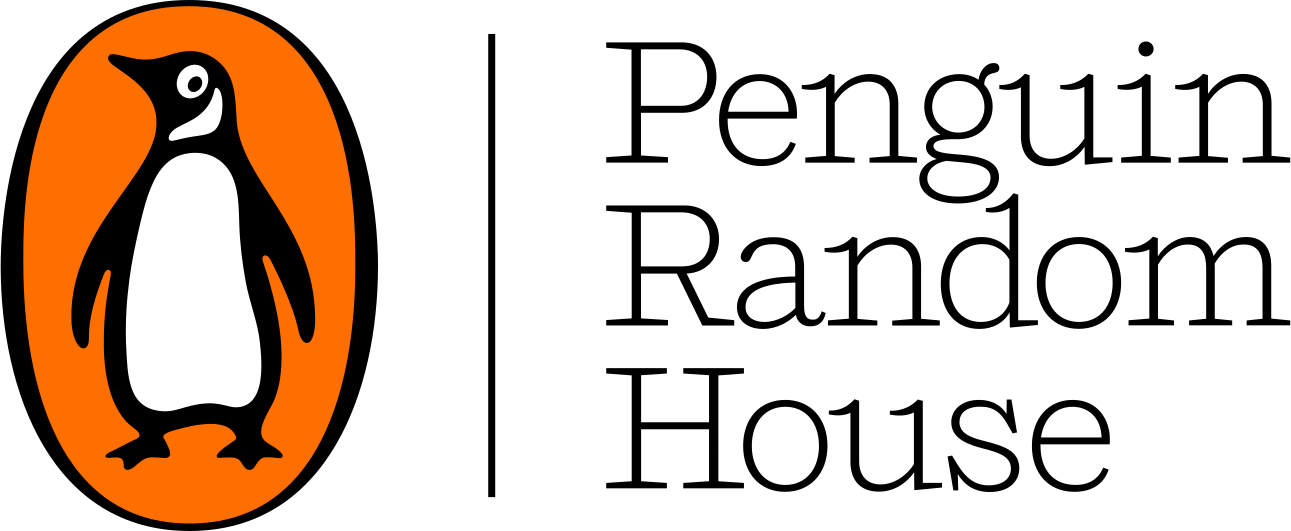
Penguin’s logo is a stylised penguin rendered in black outline against Blaze Orange (#FF6900), enclosed within an oval lozenge that has appeared on the spines and covers of paperback books for nearly nine decades. The bird stands facing forward with flippers slightly raised, its form reduced to smooth curves and minimal detail. At the corporate level, Penguin Random House pairs this mascot with a three-line serif wordmark set in Joanna Nova, designed by Pentagram partner Michael Bierut following the 2013 merger of Penguin and Random House. The penguin symbol and the corporate wordmark operate independently or together, depending on whether the context is a book spine or a corporate communication.
Edward Young, a 21-year-old office junior at Penguin Books, sketched the original penguin in 1935 after a trip to London Zoo, producing a charming but rough illustration that accompanied the publisher’s first ten paperbacks. In 1946, Jan Tschichold, the German-Swiss typographer hired by founder Allen Lane to impose rigorous design standards across Penguin’s catalogue, redrew the bird with cleaner proportions and more confident line weight. Tschichold’s version remained the definitive mark for over fifty years. In 2003, Angus Hyland at Pentagram refined the mascot again, slimming the figure by 15 percent on its vertical axis, tightening the outline, and establishing comprehensive guidelines for consistent reproduction across Penguin’s international markets. When Random House merged with Penguin in 2013, Pentagram’s Michael Bierut developed the corporate wordmark that now sits alongside the penguin symbol.
The penguin mascot succeeds because it operates at the intersection of friendliness and authority. The simple oval frame and forward-facing posture make the mark instantly legible at spine width, roughly 10 millimetres, while the Blaze Orange ground at #FF6900 ensures visibility on crowded bookshelves. Tschichold’s contribution was not just the redrawing of the bird but the codification of a complete design system: colour-coded horizontal bands (orange for fiction, green for crime, blue for biography) that turned genre classification into a visual language. That system, though now evolved, still informs how Penguin organises its imprints. The decision to use a serif typeface for the PRH corporate wordmark, rather than a sans-serif, was deliberate: Joanna Nova channels the world of printed literature the company represents.
Penguin Random House operates over 250 imprints, each carrying its own logo, from the Puffin to the colophon of Alfred A. Knopf. The corporate wordmark acts as an umbrella, pairing with individual imprint symbols in a flexible binary system. The penguin mascot continues to appear independently on book spines, on the Penguin Books website, and across the publisher’s social channels. Penguin Classics, Penguin Modern Classics, and Pocket Penguins each deploy variations of the orange lozenge, adapting the colour palette to distinguish sub-series while retaining the central bird. The colour-coding system, rooted in Allen Lane’s original 1935 decision and refined by Tschichold, remains embedded in Penguin’s publishing architecture.
The Penguin logo transcended its function as a publisher’s mark to become a symbol of accessible, democratic reading. Allen Lane’s founding principle, quality books at the price of a packet of cigarettes, found its visual expression in Young’s friendly bird, and Tschichold’s subsequent design discipline ensured that every sixpenny paperback carried the same typographic care as a luxury edition. The orange spine has become a cultural shorthand for literature itself, collected by bibliophiles and referenced in design education as a case study in how a simple mascot, consistently applied, can build brand equity across decades and continents.
Maintain adequate clear space around the Penguin Random House logo to ensure visual integrity and maximum legibility. The minimum exclusion zone equals the height of the logo's cap height (represented as "x") on all sides. This protective space prevents the logo from appearing cluttered when placed near other graphic elements, text, or page edges.
Ratio: 2.4 : 1
ViewBox: 1291 × 531
Preserve the integrity of the Penguin Random House logo by avoiding unauthorized modifications. Consistent application across all touchpoints strengthens brand recognition and maintains professional standards. The examples below illustrate common misuses that compromise the logo's visual impact and brand identity.
Don't rotate
Don't skew
Don't stretch
Don't recolor
Don't add shadows
Don't crop
Don't outline
Don't place on busy backgrounds
The Penguin Random House logo uses 3 colors: Penguin Orange (#FF6900), Black (#000000), and White (#FFFFFF). These values are used consistently across all official Penguin Random House brand materials.
Yes. Click the Download SVG button at the top of this page to get a production-ready vector file. SVG format scales to any size without quality loss, making it ideal for websites, presentations, and print materials.
The Penguin Random House logo was designed by Jan Tschichold at Pentagram in 1935. The design has become one of the better-known marks in the Publishing space.
Maintain clear space equal to the logo's cap height on all sides. Do not rotate, skew, stretch, recolor, crop, or add effects to the logo. Always use the official SVG file and ensure sufficient contrast with the background.
A reverse logo is a white or light version designed for use on dark backgrounds. It maintains the same proportions as the primary Penguin Random House logo while ensuring legibility on brand-colored surfaces, dark packaging, or apparel.
The Penguin Random House logo uses Joanna Nova. For accurate representation, always use the official vector logo rather than attempting to recreate the typography.
Commercial use of the Penguin Random House logo typically requires written permission from Penguin Random House. The logo is trademarked intellectual property, so while editorial use and accurate product references are generally permitted, promotional or commercial use needs authorization. Do not alter the logo or use it to imply endorsement.