Nespresso
Food & Beverage • In-house Nestle

 Reversed logo
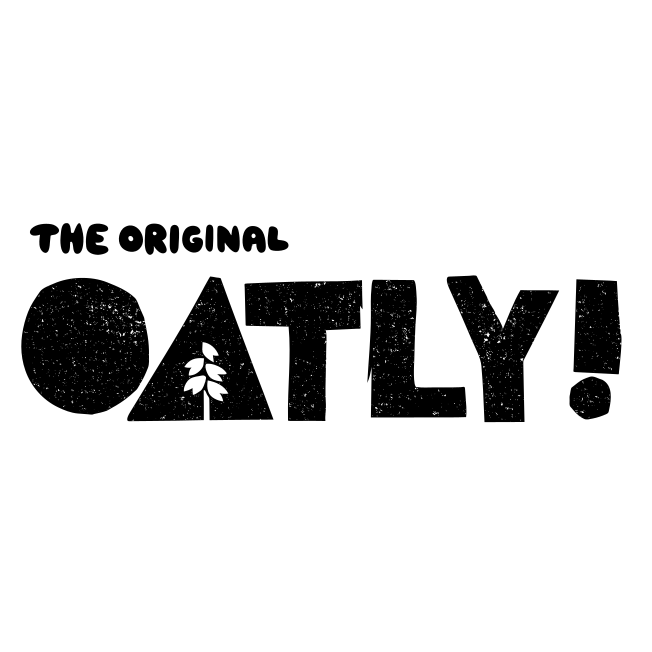
 Oatly's hand-drawn serif logotype, deliberately rough, oversized, and printed in Oatly Blue (#1B4152), breaks every rule of polished brand design on purpose. The Swedish oat milk company's visual identity treats packaging as a freeform editorial surface, turning every carton into an opinionated broadsheet.
Oatly’s logotype is a chunky, hand-drawn serif rendered in Oatly Blue (#1B4152) on white, deliberately imperfect in a way that signals honesty over polish. The letterforms are thick, slightly uneven, and tightly spaced, creating a visual weight that dominates the carton surface. No icon or symbol accompanies the wordmark; instead, the packaging itself becomes the brand’s canvas, filled with conversational copy, bold typographic statements, and a tone of voice that reads like an activist zine rather than a grocery product.
Oatly was founded in 1994 by Rickard Oste at Lund University in Sweden, but the brand remained a niche Scandinavian product for nearly two decades. The 2012 identity overhaul, led by creative director John Schoolcraft, transformed every aspect of the brand’s visual communication. The previous corporate wordmark was replaced with the hand-drawn serif, and the packaging philosophy shifted radically from conventional dairy-alternative design to the editorial, text-heavy approach that would make Oatly famous in international markets.
Oatly’s visual identity is built on the premise that packaging is media. Every surface, front panel, side panel, cap, carries typographic content in varying scales and weights, creating a reading experience rather than a passive label. The hand-drawn serif contradicts the clean minimalism expected of Scandinavian design, instead projecting a DIY authenticity that aligns with the brand’s outsider positioning in the dairy industry. Oatly Blue provides a calm, trustworthy base that counterbalances the provocative copy, while the absence of product photography on most packaging reinforces the word-first approach.
Oatly’s system is unusually copy-driven for a food brand. The visual identity manual is less about colour swatches and logo placement than about tone of voice, typographic hierarchy, and the principle that every consumer touchpoint is an opportunity for persuasion. Barista editions, cooking creams, and yogurt alternatives each feature the same hand-drawn wordmark and dense typographic packaging, creating family cohesion through voice rather than through traditional graphic uniformity. The brand’s outdoor advertising campaigns extend this approach to billboard scale, placing enormous hand-drawn text in urban environments.
Oatly’s visual identity disrupted grocery shelf conventions and demonstrated that a challenger brand could compete against dairy giants through personality rather than production values. The brand’s willingness to print self-deprecating copy, environmental arguments, and even legal disputes directly on its packaging turned cartons into cultural objects that consumers photograph and share. The approach inspired a wave of food and beverage startups to adopt editorial, text-forward packaging design, establishing a new visual category in the process.
Maintain adequate clear space around the Oatly logo to ensure visual integrity and maximum legibility. The minimum exclusion zone equals the height of the logo's cap height (represented as "x") on all sides. This protective space prevents the logo from appearing cluttered when placed near other graphic elements, text, or page edges.
Ratio: 1 : 1
ViewBox: 652 × 652
Preserve the integrity of the Oatly logo by avoiding unauthorized modifications. Consistent application across all touchpoints strengthens brand recognition and maintains professional standards. The examples below illustrate common misuses that compromise the logo's visual impact and brand identity.
Don't rotate
Don't skew
Don't stretch
Don't recolor
Don't add shadows
Don't crop
Don't outline
Don't place on busy backgrounds
The Oatly logo uses 2 colors: Oatly Blue (#1B4152) and White (#FFFFFF). These values are used consistently across all official Oatly brand materials.
Yes. Click the Download SVG button at the top of this page to get a production-ready vector file. SVG format scales to any size without quality loss, making it ideal for websites, presentations, and print materials.
The Oatly logo was designed by In-house Oatly in 2012. The design has become one of the better-known marks in the Food & Beverage space.
Maintain clear space equal to the logo's cap height on all sides. Do not rotate, skew, stretch, recolor, crop, or add effects to the logo. Always use the official SVG file and ensure sufficient contrast with the background.
A reverse logo is a white or light version designed for use on dark backgrounds. It maintains the same proportions as the primary Oatly logo while ensuring legibility on brand-colored surfaces, dark packaging, or apparel.
The Oatly logo uses Oatly Serif. For accurate representation, always use the official vector logo rather than attempting to recreate the typography.
Commercial use of the Oatly logo typically requires written permission from Oatly. The logo is trademarked intellectual property, so while editorial use and accurate product references are generally permitted, promotional or commercial use needs authorization. Do not alter the logo or use it to imply endorsement.