Technology • Ruth Kedar

 Reversed logo
Apple's monochrome silhouette, a bitten apple with a single leaf originally designed by Rob Janoff in 1977, operates in solid black (#000000, Pantone Black 6 C) or white, relying on geometric simplicity without any accompanying wordmark or color variation
Apple’s logo is a study in reduction. The bitten apple silhouette carries no accompanying wordmark, no tagline, no color fill beyond solid black (#000000, Pantone Black 6 C) or white. Rob Janoff’s original 1977 shape remains structurally unchanged: a symmetrical apple outline with a concave bite on the right side and a single leaf curving from the stem. The bite prevents the form from reading as a cherry or any other round fruit at small sizes, while the leaf anchors orientation. Geometric precision, refined by Landor Associates in 1990, gives the contour its mathematical balance.
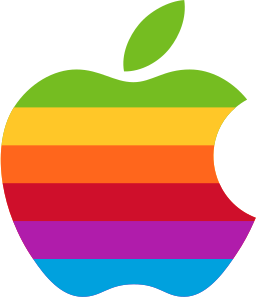
Ron Wayne drew Apple’s first logo in 1976, a pen-and-ink etching of Isaac Newton beneath an apple tree. Steve Jobs commissioned Rob Janoff at Regis McKenna’s agency to replace it within two weeks for the Apple II launch in April 1977. Janoff’s rainbow-striped version ran for 21 years, its six horizontal color bands referencing the Apple II’s color display capability. When Jobs returned in 1997, he stripped the stripes. A translucent blue appeared briefly on the 1998 iMac G3, followed by a chrome treatment from 2001 to 2007. The flat monochrome mark, in use since 2007, is the current standard across all hardware, software, and retail applications.
The mark succeeds by committing fully to abstraction. No type, no color variation, no gradient in the primary lockup. The bite serves a dual purpose: functional differentiation at small scale and an implied reference to knowledge and discovery. Janoff’s silhouette was built from studies of real apple cross-sections, then simplified until only the essential contour remained. Apple’s refusal to pair the symbol with a wordmark is itself a design decision, a confidence that the shape alone carries sufficient recognition. The monochrome palette allows the logo to adapt to any product finish, from milled aluminium to matte black ceramic.
Apple’s visual system extends the monochrome symbol across hardware, packaging, retail, and digital platforms with exacting consistency. The logo appears debossed on MacBooks, etched into stainless steel on iPhones, and backlit on Apple Store facades. Sub-brands such as Apple Music, Apple TV+, and Apple Pay append their names in San Francisco type alongside the symbol but never modify its proportions. Co-branding is tightly controlled: third-party developers receive specific guidelines for badge usage, and the symbol must never be redrawn, colorized, or placed on competing visual backgrounds.
The bitten apple has transcended its corporate origin to function as a cultural signifier for design-led technology. From the rainbow stripes on early personal computers to the glowing white on 2000s-era PowerBooks, each era’s treatment became a generational marker. The shape appears in street art, fashion, and product parody with a frequency matched by few other corporate symbols. Its longevity, nearly five decades from the same silhouette, demonstrates that geometric simplicity and restraint can outlast every design trend.
Maintain adequate clear space around the Apple logo to ensure visual integrity and maximum legibility. The minimum exclusion zone equals the height of the logo's cap height (represented as "x") on all sides. This protective space prevents the logo from appearing cluttered when placed near other graphic elements, text, or page edges.
Ratio: 1 : 1.2
ViewBox: 814 × 1000
Preserve the integrity of the Apple logo by avoiding unauthorized modifications. Consistent application across all touchpoints strengthens brand recognition and maintains professional standards. The examples below illustrate common misuses that compromise the logo's visual impact and brand identity.
Don't rotate
Don't skew
Don't stretch
Don't recolor
Don't add shadows
Don't crop
Don't outline
Don't place on busy backgrounds
The Apple logo uses 3 colors: Apple Black (#000000), Apple Grey (#A3AAAE), and White (#FFFFFF). The signature Apple Black (#000000) corresponds to Black 6 C in print. These values are used consistently across all official Apple brand materials.
Yes. Click the Download SVG button at the top of this page to get a production-ready vector file. SVG format scales to any size without quality loss, making it ideal for websites, presentations, and print materials.
The Apple logo was designed by Rob Janoff at Regis McKenna in 1998. The design has become one of the better-known marks in the Technology space.
Maintain clear space equal to the logo's cap height on all sides. Do not rotate, skew, stretch, recolor, crop, or add effects to the logo. Always use the official SVG file and ensure sufficient contrast with the background.
A reverse logo is a white or light version designed for use on dark backgrounds. It maintains the same proportions as the primary Apple logo while ensuring legibility on brand-colored surfaces, dark packaging, or apparel.
The Apple logo uses San Francisco. For accurate representation, always use the official vector logo rather than attempting to recreate the typography.
Commercial use of the Apple logo typically requires written permission from Apple. The logo is trademarked intellectual property, so while editorial use and accurate product references are generally permitted, promotional or commercial use needs authorization. Do not alter the logo or use it to imply endorsement.